 Mintable
 Gasless Minting used a signed message instead of a creator-submitted transaction, with separate evidence for item creation and wallet visibility.
Updated on
Mintable Gasless Minting let a creator prepare an ERC-721 item on Ethereum mainnet by signing a message rather than paying for an initial blockchain transaction. Mintable displayed the item in its gasless store, but many wallets did not discover it until a later sale or manual transfer emitted the Transfer event they monitored. Mintable announced the marketplace and Mintology sunset in 2026, so this page explains setup evidence for existing items rather than a dependable route for a new mint.
What had to be ready before the first gasless mint?
The setup needed a Mintable account, an Ethereum address that could receive the item, complete NFT details, and access to sign the creation message. The item fields established what the platform displayed, while the address connected the record to its intended owner. A connected self-custodial wallet or Mintable's custodial wallet could supply that address, depending on the account path then in use. The creator did not need ETH for the initial gasless creation step.
Before signing, the creator needed to confirm that the selected route was the Mintable Gasless Store on Ethereum mainnet and that the account showed the intended address. The message signature authenticated the creation instruction. It was not an Ethereum transaction, did not move ETH, and did not create a transaction receipt. An unexpected account, address, or action was a reason to reject the request and correct the setup.
The signed creation message and a later blockchain transaction therefore left different evidence.
The missing Transfer event changed wallet visibility
Mintable's gasless method emitted no Transfer event at creation; a purchase or manual transfer produced that event later.
A blank wallet gallery therefore did not prove that the creation step had failed. The Mintable item record, contract address, and token ID supplied more relevant evidence for that stage. Some wallets also allowed manual NFT import with the contract address and token ID, although support depended on the wallet. Manual import changed the interface display, not the token's ownership record.
A later transfer created a different checkpoint. Its transaction status and expected addresses showed whether the blockchain action completed, while the emitted event gave wallet indexers something to discover.
Five checkpoints from item draft to wallet-visible transfer
A creator could stop at the first unmet prerequisite instead of treating every missing display as the same failure. Complete item data marked the entry point, the signed message authorized creation, and the final check depended on whether the goal was a saved item record or wallet visibility.
| Stage | Completion evidence | Prerequisite before continuing |
|---|---|---|
| Prepare the item | The account draft contains the intended title, description, and media fields. | Account access and the intended Ethereum address. |
| Select gasless creation | The gasless store route and Ethereum mainnet context appear before authorization. | The correct account and minting route. |
| Authorize creation | The creator signs the message with the intended account without submitting a blockchain transaction. | Control of the signing account and a request that matches the intended action. |
| Confirm the item record | The displayed record supplies a contract address and token ID for the created item. | A completed creation signature and access to the account's item records. |
| Confirm the later transfer | A sale or manual transfer records the expected transaction and Transfer event. | An existing item, authority to transfer it, and ETH for transaction gas when the sender must pay it. |
If the signing step never completed, the creator could correct the account or address before trying again. If the item already had identifiers but lacked a Transfer event, repeating creation risked producing a separate record. The safer next check concerned the existing identifiers and event history. Once the expected transfer appeared with the intended addresses, another mint was unnecessary. The sunset announcement means these historical marketplace actions should no longer be assumed to be available.
Token, listing, and media records answered different questions
Each record covered a separate part of completion. Contract data identified the NFT, a marketplace listing expressed an offer, metadata supplied descriptive content, and a wallet interface presented an indexed view.
Contract identity and ownership
ERC-721 identifies each NFT with a token ID that is unique within its contract.
Contract address
The contract address distinguished the shared Mintable Gasless Store contract and its code from other ERC-721 contracts. A familiar title or thumbnail could not replace that address because different contracts may display similar names or media. Preserving the exact contract address matters after a marketplace closes or changes its interface.
Token ID and owner
The token ID selected one item within the contract. Read together, the contract address and token ID formed the durable identifier for the NFT. The owner address answered a different question: which Ethereum address currently held that item. A listing could appear, expire, or disappear without changing the owner.
Metadata and marketplace state
Metadata supplied the title, description, attributes, and media reference that an interface could render. A missing image could reflect a metadata or retrieval problem even when the contract identity and owner record remained intact. Checking those layers separately avoided treating a display failure as proof that the NFT had vanished.
The listing also stood apart from the token. Canceling or losing access to a marketplace offer did not burn the ERC-721. Burning required a separate blockchain action, while removing a listing only changed whether that venue offered the item for sale.
Each failed stage required a different check
Before retrying, identify whether the failure occurred during data entry, message authorization, item registration, metadata display, or transfer confirmation.
Repeating every step could create confusion, especially after the item record already existed. Evidence from the last completed stage showed whether another attempt was needed and where to resume.
- A rejected message left no signed creation authorization. Another attempt only made sense after confirming the intended account, address, and action.
- A completed signature without a saved item record left creation unconfirmed. Existing identifiers or account records needed checking before another signature.
- An item record without a wallet thumbnail called for contract, token ID, and event checks rather than another mint.
- A failed manual transfer left the expected ownership change incomplete. The transaction status carried more weight than a loading message or notification.
- An unexpected destination address was a stopping point. Repeating the same action could reproduce the mismatch instead of correcting it.
A normal message signature did not require the creator to reveal a seed phrase or private key. Those secrets control the wallet itself, so entering them into a creation prompt would expose far more authority than the gasless step needed. Rejecting an unexpected request preserved the option to resume from the same item data with the correct account.
After the sunset announcement, preserving known contract addresses, token IDs, owner addresses, and transaction hashes became more useful than relying on a marketplace dashboard. Those records also helped separate an unavailable interface from a missing blockchain record.
Gasless and traditional minting produced different first proofs
Gasless and traditional minting differed chiefly in whether the creator submitted an initial transaction and when a Transfer event appeared. In the traditional route, the creator authorized an Ethereum transaction, paid the required gas, and received a transaction result for the mint. Mintable's gasless route replaced that initial transaction with a signed message and charged no creator gas for that creation step.
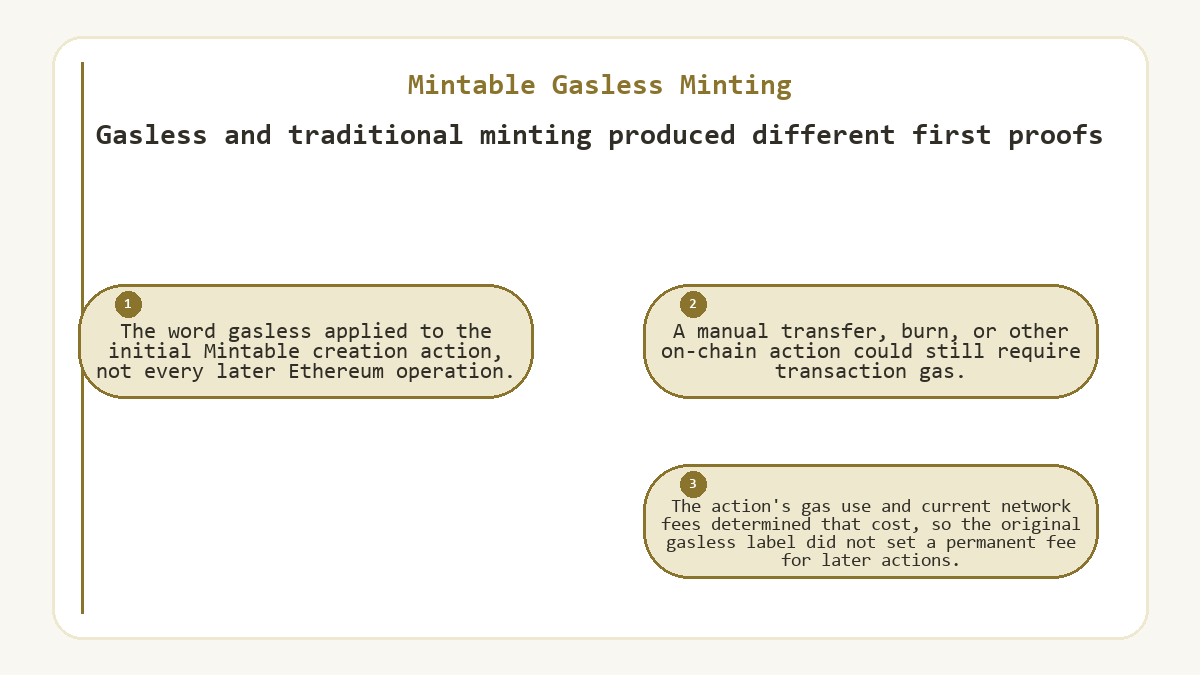
The word gasless applied to the initial Mintable creation action, not every later Ethereum operation. A manual transfer, burn, or other on-chain action could still require transaction gas. The action's gas use and current network fees determined that cost, so the original gasless label did not set a permanent fee for later actions.
Mintable described its gasless items as ERC-721 tokens on Ethereum mainnet rather than tokens waiting for a buyer to perform a delayed mint. That distinction shaped the completion test: the item record and identifiers supported the creation check, while a later transfer supplied the event that many wallet interfaces expected. Traditional minting gave immediate transaction proof at creation; Mintable's gasless route shifted the first wallet-visible event to a later transfer.
Quick answers about Mintable Gasless Minting
-
Did a gasless creation signature send an Ethereum transaction?
- No. The Mintable creation step used a signed message instead of a creator-submitted Ethereum transaction, so it did not produce a mint transaction receipt or charge the creator gas. The signature authorized the platform workflow. A later sale or manual transfer was a separate blockchain action with its own transaction evidence.
-
Which token standard did the Mintable Gasless Store use?
- The Mintable Gasless Store used ERC-721 tokens on Ethereum mainnet. Each item could therefore be identified by its contract address and token ID. Mintable's creator documentation treated ERC-1155 as unsupported for this route, so an ERC-1155 record would not match the documented gasless-store setup.
-
Where was a Mintable gasless NFT recorded before a wallet displayed it?
- Mintable represented the item as an ERC-721 on Ethereum mainnet and displayed it through the gasless store. Many wallet galleries did not show it until a later Transfer event or a supported manual import. The contract address and token ID were more useful for identifying the item than a missing thumbnail.
-
Does the gasless label cover later Ethereum transfers?
- No. Gasless referred to the creator's initial Mintable creation step. A later manual transfer, burn, or other Ethereum transaction could still require the sender to pay gas in ETH. The required amount depended on the transaction and network conditions, so the creation method did not set a lasting fee for future actions.
-
Would sending the item to the same address change its owner?
- A transfer to the same address would leave the owner address unchanged, but Mintable documented it as a way to produce the Transfer event that wallet indexers could detect. The sender still needed authority over the item, and the manual Ethereum transaction could require gas even though the original creation was gasless.
-
Could removing a marketplace listing burn the ERC-721?
- No. A listing was an offer managed separately from the token's ownership record. Canceling or losing a listing did not burn the ERC-721. Burning required a distinct blockchain transaction to an appropriate burn destination, and that irreversible action had different evidence from removing an item from sale.
-
Does the token record prove that the minter owns the underlying copyright?
- No. A token record can show the contract, token ID, owner address, and transaction history, but it does not by itself prove copyright ownership in the associated media. Copyright ownership and permitted commercial uses depend on copyright law and any license or transfer terms, not the token record alone. Minting copied material cannot create rights that the minter did not possess.
-
What changed after Mintable announced its 2026 sunset?
- The announced sunset made Mintable gasless minting an unreliable route for starting a new item. It did not erase existing Ethereum ownership and transaction records. Holders of earlier items should preserve their contract addresses, token IDs, owner addresses, and relevant transaction hashes instead of relying only on marketplace pages or wallet thumbnails.